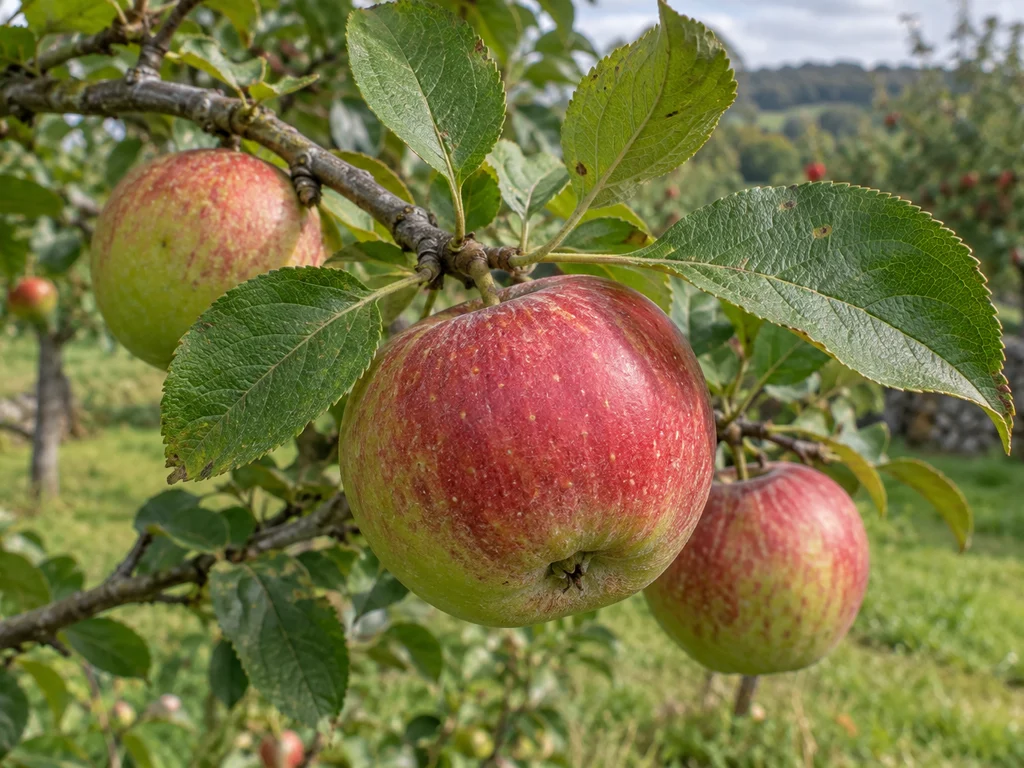
AI-generated illustration — check edibility and toxicity notes, never eat from the picture alone.
Apple
Malus domestica
The backbone of most UK food forests. Pick a rootstock for the size you want (dwarfing M27/M9 for small gardens, MM106/MM111 for bigger trees), underplant with comfrey and a nitrogen fixer, and keep the canopy open with winter pruning.
An apple is the round, edible fruit of an apple tree. Fruit trees of the orchard or domestic apple, the most widely grown in the genus, are cultivated worldwide. The tree originated in Central Asia, where its wild ancestor, Malus sieversii, is still found. Apples have been grown for thousands of years in Eurasia before they were introduced to North America by European colonists. Apples have cultural significance in many mythologies and religions.
Description from Wikipedia (CC BY-SA).
At a glance
- Sunlight
- Full sun
- Water need
- Medium
- Mature height
- 4 m
- Maintenance
- Medium
- Hardiness
- USDA 4–8
- Layers
- canopy
Functional roles
Pollination & soil
Most apples need a compatible variety flowering at the same time nearby; a crab apple pollinates many.
- Soil
- medium/loam, heavy/clay
- pH
- Neutral
Deep, fertile, moisture-retentive loam; avoid waterlogged ground.
Propagation
How to make more of this plant for free — the permaculture way.
When: Graft (whip-and-tongue) late winter
Cultivars don't come true from seed; graft onto a rootstock chosen for size.
Cultivars
Buy the cultivar, not just the species. “Ready” means its size and pollination are sourced; anything else needs confirming with the supplier first.
- DiscoveryReady
The first apple of the year and worth growing for that alone — but it will not crop on its own, so it needs a partner flowering in group 2, 3 or 4. Eat it within days; it does not keep.
- Uses
- eating
- Mature spread
- Not yet checked
- Pollination
- self-incompatible
Pollination: Royal Horticultural Society, Royal Horticultural Society
Sold on: M27, M9, M26, MM106, MM111
- Egremont RussetReady
Dry, nutty and quite unlike a supermarket apple. Flowers early, so it suits a sheltered spot, and it will set some fruit alone.
- Uses
- eating
- Mature spread
- Not yet checked
- Pollination
- partially-self-fertile
Pollination: Royal Horticultural Society, Royal Horticultural Society
Sold on: M27, M9, M26, MM106, MM111
- James GrieveReady
Heavy blossom makes it one of the most useful pollinators in a small orchard, including for triploids. The fruit bruises easily, which is why you rarely see it in shops.
- Uses
- dual
- Mature spread
- Not yet checked
- Pollination
- partially-self-fertile
Pollination: Royal Horticultural Society, Royal Horticultural Society
Sold on: M27, M9, M26, MM106, MM111
- SunsetReady
Cox flavour without Cox's temperament — much easier in a wet western garden.
- Uses
- eating
- Mature spread
- Not yet checked
- Pollination
- partially-self-fertile
Pollination: Royal Horticultural Society, Royal Horticultural Society
Sold on: M27, M9, M26, MM106, MM111
- Bramley's SeedlingReady
The cooking apple, and a big tree. Being triploid it pollinates nothing and needs TWO other compatible varieties nearby to crop — a single Bramley in a garden is a common and expensive mistake.
- Uses
- cooking, storage
- Mature spread
- Not yet checked
- Pollination
- triploid
Pollination: Royal Horticultural Society, Royal Horticultural Society
Sold on: M27, M9, M26, MM106, MM111
- Charles RossConditional
Big handsome fruit that cooks and eats. Recorded on the nursery A–F chart as group C, with some charts placing it C/D.
- Uses
- dual
- Mature spread
- Not yet checked
- Pollination
- partially-self-fertile
Pollination: Keepers Nursery, NIAB
Sold on: M27, M9, M26, MM106, MM111
- floweringGroup is disputed and cannot stand as a settled recommendation fact.
- FiestaReady
A late eater that actually keeps, so it carries the fruit bowl past Christmas. Recorded on the nursery A–F chart as group D.
- Uses
- eating, storage
- Mature spread
- Not yet checked
- Pollination
- partially-self-fertile
Pollination: Keepers Nursery, NIAB
Sold on: M27, M9, M26, MM106, MM111
- Howgate WonderReady
Enormous cooking apples that hold their shape; an alternative to Bramley that is not triploid, so it is far easier to pollinate.
- Uses
- cooking, storage
- Mature spread
- Not yet checked
- Pollination
- partially-self-fertile
Pollination: Keepers Nursery, NIAB
Sold on: M27, M9, M26, MM106, MM111
- Ashmead's KernelReady
A three-hundred-year-old russet with an intense sharp-sweet flavour. Triploid, so like Bramley it needs two other compatible varieties and pollinates none of them.
- Uses
- eating, storage
- Mature spread
- Not yet checked
- Pollination
- triploid
Pollination: Keepers Nursery, NIAB
Sold on: M27, M9, M26, MM106, MM111
Companions & conflicts
- ✓Comfrey (Bocking 14) — Comfrey under the drip line for chop-and-drop mulch and nutrients.
- ✗Walnut — Sensitive to walnut's juglone; keep well away from walnuts.
Where to get it
Read more
Seed data pending expert review. Identification photo and description are sourced from Wikipedia/Wikimedia; always confirm a plant in person before eating any part of it.