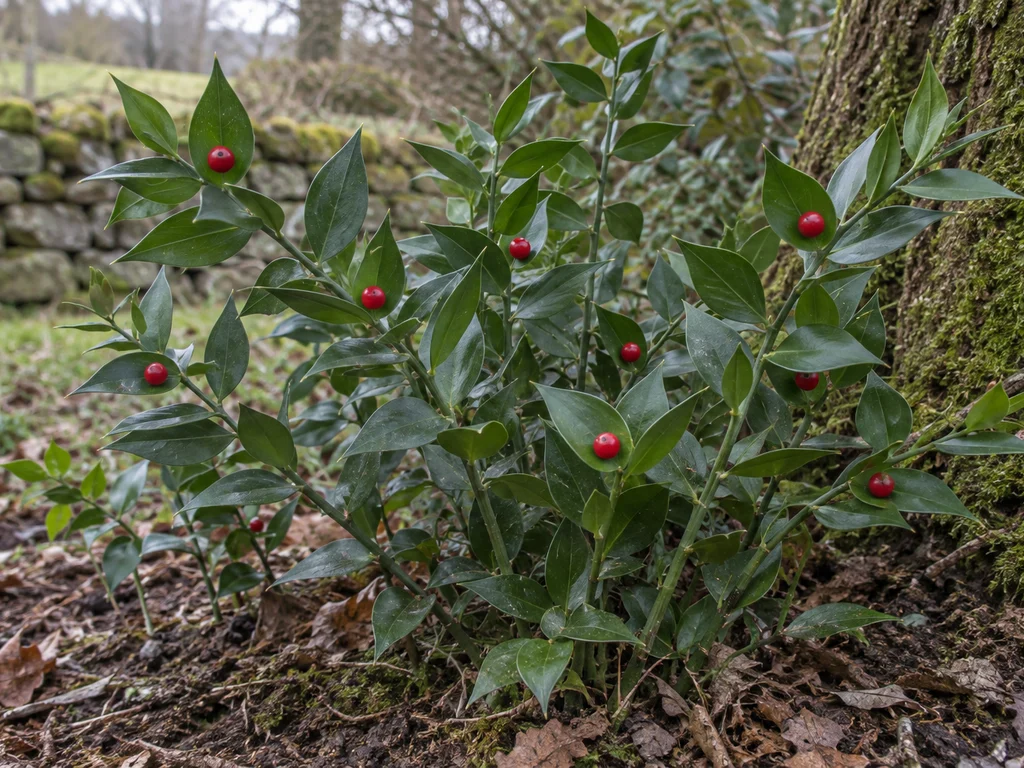
AI-generated illustration — check edibility and toxicity notes, never eat from the picture alone.
Butcher's Broom
Ruscus aculeatus
Ruscus aculeatus, known as butcher's-broom, is a low evergreen dioecious Eurasian shrub, with flat shoots known as cladodes that give the appearance of stiff, spine-tipped leaves. Small greenish flowers appear in spring, and are borne singly in the centre of the cladodes. The female flowers are followed by a red berry, and the seeds are bird-distributed, but the plant also spreads vegetatively by means of rhizomes. It is native to Eurasia and some northern parts of Africa. Ruscus aculeatus occurs in woodlands and hedgerows, where it is tolerant of deep shade, and also on coastal cliffs. Likely due to its attractive winter/spring color, Ruscus aculeatus has become a fairly common landscape plant. It is also widely planted in gardens, and has spread as a garden escapee in many areas outside its native range. The plant grows well in zones 7 to 9 on the USDA hardiness zone map.
Description from Wikipedia (CC BY-SA).
At a glance
- Sunlight
- Deep shade
- Water need
- Low
- Mature height
- 0.8 m
- Maintenance
- Low
- Hardiness
- USDA 7–9
- Layers
- shrub, groundcover
Functional roles
Propagation
How to make more of this plant for free — the permaculture way.
When: Divide spring
Native evergreen for dry deep shade where almost nothing grows; young shoots are edible like asparagus.
Where to get it
Read more
Seed data pending expert review. Identification photo and description are sourced from Wikipedia/Wikimedia; always confirm a plant in person before eating any part of it.