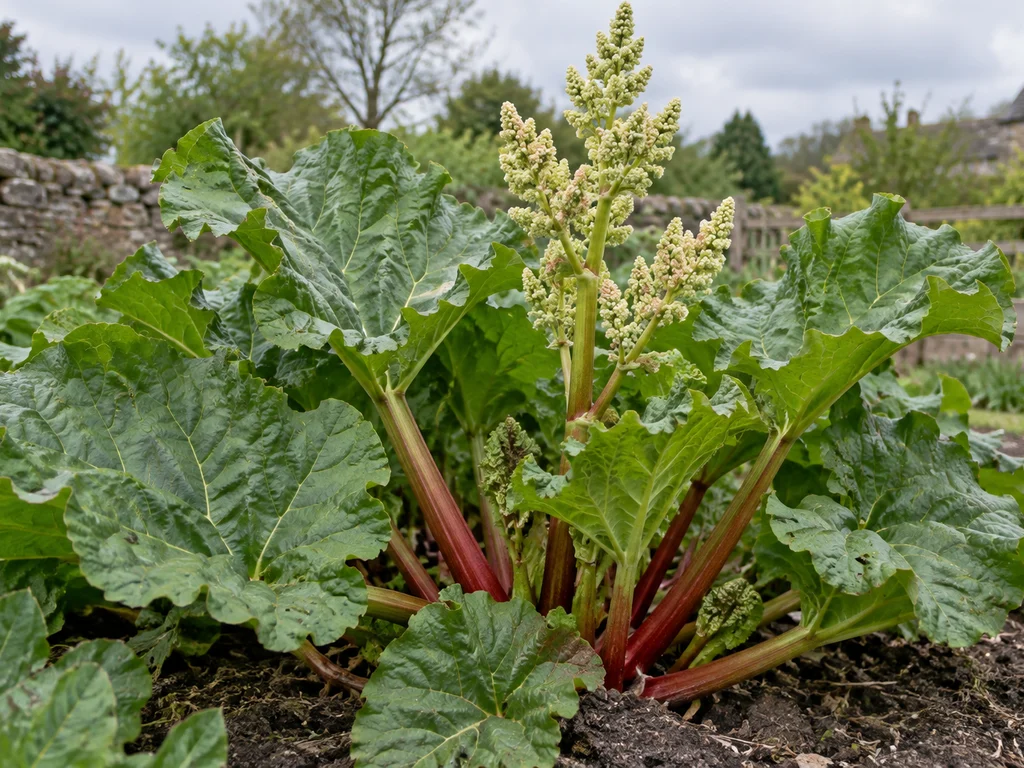
AI-generated illustration — check edibility and toxicity notes, never eat from the picture alone.
Rhubarb
Rheum rhabarbarum
A near-indestructible perennial; feed it with muck, never pull after midsummer, and remember the leaves are poisonous (stalks only).
Rheum rhabarbarum is a species of flowering plant in the family Polygonaceae, native to a region stretching from southern Siberia to north and central China. It has been harvested from the wild for centuries for its root, which was harvested for use as a popular medicine in Europe and Asia. It was later cultivated for its root in England and Russia. It is considered to be one of the species involved in the development of culinary rhubarb, for which the scientific name R. rhabarbarum is sometimes (erroneously) used.
Description from Wikipedia (CC BY-SA).
⚠ Safety
Leaves are toxic (oxalic acid). Eat the stalks only.
At a glance
- Sunlight
- Partial shade
- Water need
- Medium
- Mature height
- 1 m
- Maintenance
- Low
- Hardiness
- USDA 3–8
- Layers
- herb
Functional roles
Pollination & soil
- Soil
- medium/loam, heavy/clay
- pH
- Neutral
Deep, rich, moisture-retentive soil.
Propagation
How to make more of this plant for free — the permaculture way.
When: Divide dormant crowns winter
In the kitchen garden
- Sow (months)
- Not yet checked
- Harvest (months)
- Not yet checked
- Spacing
- Take it from the seed packet
- Family
- —
- Frost
- Not yet checked
Early stems each spring without replanting. Leave new crowns alone the first year to establish, and never eat the leaves.
Where to get it
Read more
Seed data pending expert review. Identification photo and description are sourced from Wikipedia/Wikimedia; always confirm a plant in person before eating any part of it.